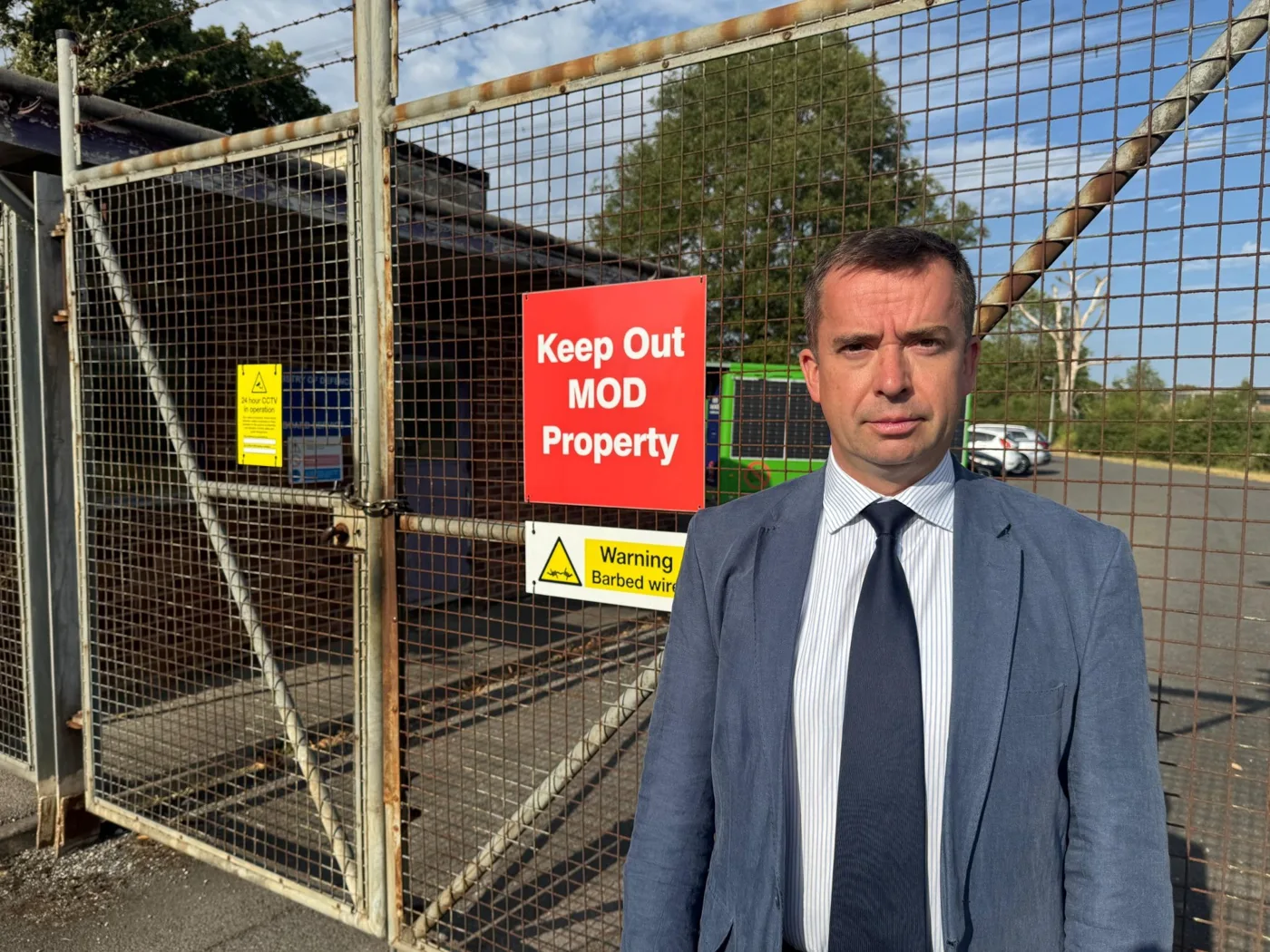

A Commons committee voted 8 to 6 against making ministers publish suitability checks on big asylum sites. Bicester's MP has already tabled the idea again.
Ministers will not have to publish a suitability assessment before opening large asylum sites such as MOD Bicester, after Labour MPs voted the idea down 8 to 6. The vote came in the committee examining the Immigration and Asylum Bill on Tuesday 3 November. The clause was written by Calum Miller, the Liberal Democrat MP for Bicester and Woodstock, and he has already put it down again for the Bill’s next stage.
The vote does not decide the plan for up to 1,256 people at Site A for ten years. That is still a planning application waiting for the Secretary of State, and the Government’s page shows no decision.
What the two clauses said
Mr Miller tabled two new clauses. Both applied to any single site meant for 300 or more people, and both would have required publication before anyone was housed there.
- NC30, site suitability. Ministers would assess access to public transport and essential services, pressure on local healthcare and policing, pedestrian access, safeguarding, environmental and infrastructure constraints, alternative sites and the impact on the local community. They would also have to consult the local authorities for the area.
- NC31, costs. Ministers would publish the estimated cost of securing the site, building or adapting it and running it each year, the total over its life, the cost per person and a comparison with alternatives. They would have to revise the figures if they changed materially before opening.
Neither clause would have stopped a site by itself. They set out what had to be published first.
How the vote went
Only NC30 went to a vote. Mr Miller’s office said both amendments were voted down, but Parliament’s record says NC31 was debated alongside it and not put to a vote. Neither is in the Bill.
| Vote | Party | MPs |
|---|---|---|
| For (6) | Conservative | Blake Stephenson, Joe Robertson, Matt Vickers |
| For (6) | Liberal Democrat | Tom Gordon, Paul Kohler |
| For (6) | Green | Siân Berry |
| Against (8) | Labour | Anna Turley, Melanie Onn, Adam Thompson, Jonathan Brash, Paul Foster, David Smith, Jade Botterill, Catherine Fookes |
Neither Mr Miller nor Sean Woodcock, the Labour MP for Banbury, was among the 14 who voted. Tom Gordon, the Liberal Democrat MP for Harrogate and Knaresborough, moved the clause on Mr Miller’s behalf. Sir Alec Shelbrooke, a Conservative, had also signed both.
What Bicester’s MP said
“Residents around MOD Bicester have been asking perfectly reasonable questions about this proposal for months,” Mr Miller said. “How will people get safely to and from the site? Can local services cope? What will the full bill be?
“My amendments would have required ministers to publish the evidence on suitability and cost before opening large asylum sites. Labour MPs had the opportunity to put those basic safeguards into law. They chose to vote them down.
“The Government wants to put up to 1,256 people on a former military storage site for a decade. The unresolved questions about safe access, sewage and power will not disappear because Labour has rejected greater scrutiny.
“I remain firmly opposed to this plan for MOD Bicester. I will keep standing up for local residents and pressing the Government for answers. Residents deserve to know what is being proposed in their name, and taxpayers deserve to know what they are being asked to pay.”
What was said about Bicester in committee
Mr Gordon told the committee that the urgent Crown development route “allows the Home Office to bypass much of the usual planning scrutiny”. He made these claims about the Bicester application:
- the sewage arrangements rely on tankering, “which would not work at full occupancy”;
- the electricity plan assumes generators, “because the existing supply cannot be relied on”;
- the environmental screening assumed buildings no higher than 6 metres, while the plans allow up to 12 metres;
- there were no pre-application discussions with the highways authority.
“If a site is suitable, why not publish the evidence, and if it represents value for money, why not publish the costs?” he asked.
Those concerns echo the ones in Cherwell’s response and the objections from three councils.
The £1 billion figure
Mr Miller’s own analysis, reported by The Times in September, estimated the site could cost more than £250 million to set up and potentially more than £1 billion over ten years. That is his estimate, not a Government figure. The Government has not published one: a Home Office minister told MPs on 14 October that the final cost “will only be known following the outcome of the procurement process”. Thames Valley Police has separately put policing at about £1.7m a year during construction.
What the Government said
Anna Turley, the Minister for Border Security and Asylum, said the Government agreed with the aim, but that site selection already involves assessing safety, safeguarding, service capacity and local impact.
On engagement with councils, she said a single statutory model “could duplicate existing processes, require premature disclosure and delay urgent decisions”.
On costs, she said: “We will be as transparent as we possibly can, whenever we can. We have to balance publication against commercial confidentiality, personal data and site security and the need to protect sensitive operational information.”
Challenged on why local councils were wrong to oppose such sites, she said that “nimbyism” gets used quite a lot, then added that it was important for local authorities to make representations “whatever their political party”, and that all of them would be taken into account.
Joe Robertson, the Conservative MP for Isle of Wight East, asked how housing more than 1,000 people beside a smaller settlement could be right. Ms Turley replied: “We are not housing them in the community. They are being housed on a specific site that is self-contained and away from the community.”
She said two large sites are already running, at Wethersfield and Crowborough, with three more in the pipeline. She did not name those three in that answer.
What it means for you
- The Bicester decision is still to come. This vote was about the law on future publication, not about Site A. Representations on the application closed on 17 September.
- The argument has one more Commons round at least. Mr Miller has tabled the same two ideas as NC1 and NC2 for report stage, when the whole House considers the Bill. Parliament has not yet listed a date.
- All MPs can vote at that stage, unlike the 14 on Tuesday’s committee. Bicester and the villages around Site A are in Bicester and Woodstock. Banbury and the north of the district are in Banbury.
We will report the Site A decision when the Government publishes it.
Have your say