
Band D in Banbury is £2,603.38 this year, up 3.2 per cent. The full A to H table, plus what the county, the police and the town council each take from it.
A Band D property in Banbury pays £2,603.38 in council tax this year. In Bicester it is £2,612.96. Cherwell District Council sends the bill and keeps £163.50 of it.
Below is the full A to H table for Banbury, the same for Bicester, and the part the council’s own pages make hardest to find: which body takes what, and what each of them put up.
Banbury council tax bands 2026/27
| Band | 1991 value | Charge for the year |
|---|---|---|
| A | Up to £40,000 | £1,735.58 |
| B | £40,001 to £52,000 | £2,024.86 |
| C | £52,001 to £68,000 | £2,314.11 |
| D | £68,001 to £88,000 | £2,603.38 |
| E | £88,001 to £120,000 | £3,181.90 |
| F | £120,001 to £160,000 | £3,760.44 |
| G | £160,001 to £320,000 | £4,338.96 |
| H | Over £320,000 | £5,206.76 |
Source: Cherwell District Council, Council Tax Charges 2026/2027 - Banbury.
The 1991 values are not a mistake. Every band in England still rests on what the property was worth on 1 April 1991, and there has never been a revaluation.
Bicester council tax bands 2026/27
| Band | Charge for the year |
|---|---|
| A | £1,741.97 |
| B | £2,032.31 |
| C | £2,322.63 |
| D | £2,612.96 |
| E | £3,193.61 |
| F | £3,774.28 |
| G | £4,354.93 |
| H | £5,225.92 |
Source: Cherwell District Council, Council Tax Charges 2026/2027 - Bicester.
Cherwell publishes a table like this for all 79 parishes, one page each. If you live in Bloxham, Adderbury, Bodicote, Deddington, Hook Norton or anywhere else in the district, your figure is on that list.
Where the money actually goes
Only 6.33 pence in every pound of your bill stays with Cherwell District Council.
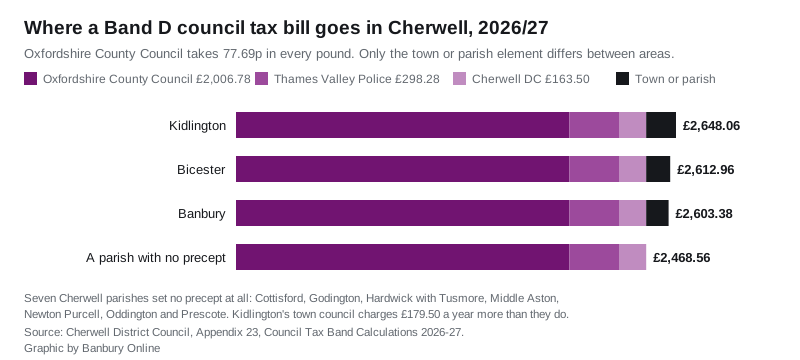
At Band D, the four parts of a Banbury bill are:
| Who | Band D charge | Share of the bill | Change this year |
|---|---|---|---|
| Oxfordshire County Council | £2,006.78 | 77.69% | up £95.38, or 4.99% |
| Thames Valley Police and Crime Commissioner | £298.28 | 11.55% | up £15.00 |
| Cherwell District Council | £163.50 | 6.33% | up £5.00, or 3.2% |
| Banbury Town Council | £134.82 | 4.43% | see below |
| Total | £2,603.38 |
Sources: Cherwell District Council, Appendix 23, Council Tax Band Calculations 2026-27 and How your Council Tax is calculated. The percentage shares are the council’s own, calculated against the district average Band D of £2,582.96.
The county council is the increase. Oxfordshire took the maximum the government allows, 4.99 per cent, of which 2 per cent is the adult social care precept and the rest is the general limit. In cash, that one decision added £95.38 to a Band D bill.
The police added £15, which the Police and Crime Commissioner’s own council tax leaflet describes as “£15 a year or 29p per week for a Band D household”. The force’s net revenue budget for 2026/27 is £622 million, up £27 million or 4.5 per cent.
Cherwell added £5. Its Band D charge went from £158.50 to £163.50, a 3.2 per cent rise agreed at the council meeting on Monday 23 February 2026. The council says 32 per cent of its funding for services comes from council tax, the rest from government grants and business rates.
Banbury Town Council raised £2,384,754 for 2026/27. Divided by the town’s tax base of 17,688.3 Band D equivalents, that is £134.82 per Band D property.
Why your neighbours pay a different amount
The county, police and district elements are identical everywhere in Cherwell. The only thing that changes between one part of the district and another is the town or parish precept, and the spread is wider than most people expect.
- Kidlington is the most expensive parish in the district at £2,648.06 at Band D. Its parish element is £179.50.
- Seven parishes set no precept at all and pay £2,468.56: Cottisford, Godington, Hardwick with Tusmore, Middle Aston, Newton Purcell, Oddington and Prescote.
- The gap between those two is £179.50 a year for identical properties in the same district, receiving the same county and district services.
Banbury sits at £2,603.38, above the district average of £2,582.96. Bicester at £2,612.96 is slightly above Banbury.
How to check and challenge your band
Your band is on your bill. If you do not have it to hand, the Valuation Office Agency publishes the band for every address in England.
The VOA, not the council, decides bands. Cherwell’s explanatory notes list the grounds on which you can ask for a review:
- the value went up because of building or structural work, usually challenged by the new owner after a sale
- the value went down because of partial demolition, or adaptations for a resident with a physical disability
- part of the property has started or stopped being used for business
- within six months of the VOA or a Valuation Tribunal changing your band
- within six months of becoming the council tax payer for the property for the first time
The VOA can be contacted online or on 03000 501 501. Keep paying at the current band while the challenge is considered. Nothing is suspended while you wait, and a successful appeal is refunded afterwards.
If your argument is with the council rather than the valuation, for instance that you are not the liable person or the bill has been calculated wrongly, that goes to Cherwell’s Revenue Services team in writing first, and only then to an independent tribunal.
Discounts and premiums
A full bill assumes two adults aged 18 or over living in the property as their main home.
Single person discount: 25 per cent. One adult only, as their sole or main residence. It cannot be claimed by the same person at two properties, or by partners living apart purely because of work or holidays.
Certain adults are disregarded, which can bring the household count below two even if more people live there. The list includes full-time students and student nurses, apprentices earning under £195 a week, hospital in-patients, care home residents, people who are severely mentally impaired, low-paid carers, people caring for someone with disabilities, 18 and 19 year olds who have just left school, and people in detention.
Empty and unfurnished: 25 per cent for up to six months, then the full charge. The six months does not restart when the property changes hands. There is no discount at all for a property needing or undergoing structural repair.
Long term empty premiums have applied since 1 April 2025 and are steep:
- 100 per cent premium: empty and unfurnished for 1 to 5 years
- 200 per cent premium: 5 to 10 years
- 300 per cent premium: 10 years or more
The premium attaches to the property, not the owner, and survives a sale or a change of tenant.
Second homes get no discount now, and from 1 April 2027 a 200 per cent charge will apply. The only exception is a furnished property provided by an employer, occupied as part of a contract of employment, within the grounds of the workplace, which can qualify for a 50 per cent discount.
Annexes occupied by a relative of the main household can get a 50 per cent reduction where planning restrictions prevent them being let or sold separately.
Homes for Ukraine: a 50 per cent discount for a Ukrainian national in the UK under the sponsorship scheme who is occupying their own accommodation rather than their sponsor’s home.
If you are on a low income, the scheme to apply for is Council Tax Reduction. Everything else goes through apply for a discount or exemption.
More Banbury local information: bin collection days, parking, house prices and planning news.
Have your say