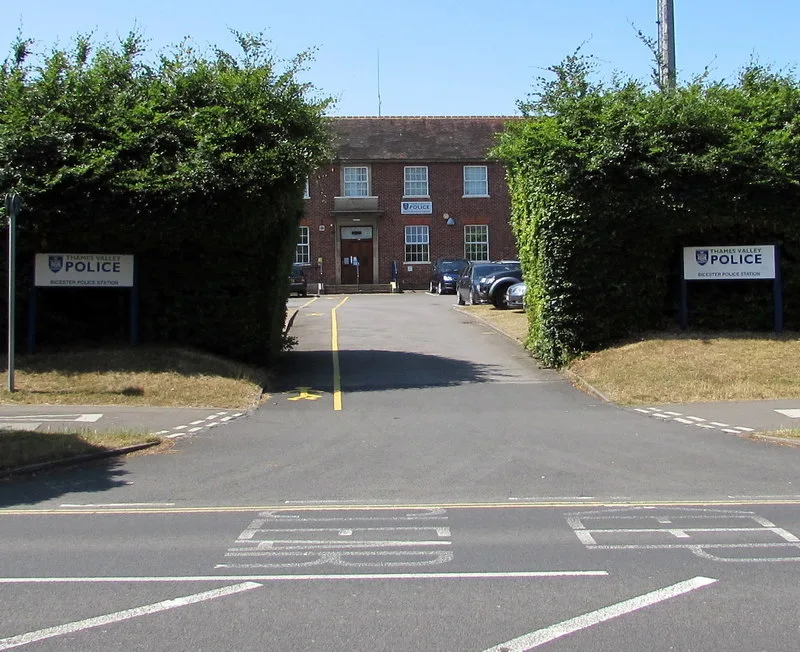

Thames Valley's commissioner says policing the MOD Bicester camp would cost £1.7m a year. The Home Office grant that would pay it excludes his biggest worry.
Policing the asylum camp proposed at MOD Bicester would cost Thames Valley Police about £1.7 million a year during construction alone. That is the force’s own estimate, published on 22 September by the Police and Crime Commissioner, Matthew Barber.
Barber has written to the Minister for Border Security and Asylum, the Rt Hon Anna Turley MP, asking for the full cost to be met by the government. His statement sets out two pressures: neighbourhood policing once the camp is occupied, and managing protest at the site before it is.
“I am extremely concerned about the additional burden the Government’s proposed asylum camp at MOD Bicester will have on local policing,” he said.
“The force has reviewed the numbers and, if planning permission was to be granted at the site, we estimate the additional cost to Thames Valley Police would be around £1.7 million per annum during the construction phase.”
Two details in that sentence matter. The estimate is conditional on permission being granted, which the Secretary of State has not yet decided. And it covers the construction phase, not the years the camp would be in use.
The cost he says will not show up in the £1.7m
Barber’s own framing is that the cash figure understates the problem.
“However, this is only the cash cost,” he said. “There will also be a considerable impact on our workforce and effectiveness as officers and resources will, inevitably, have to be redeployed across the force to meet operational needs around the camp leading to less visible, proactive policing in other parts of the Thames Valley.”
That is the part the grant he would apply for is written to exclude.
What the grant pays for, and what it does not
There is a dedicated Home Office scheme for exactly this situation. It is set out in Large sites for asylum accommodation: support for police forces, guidance piloted from June 2023, revised in January 2026 and last updated on 2 March 2026. Former Ministry of Defence sites are explicitly in scope.
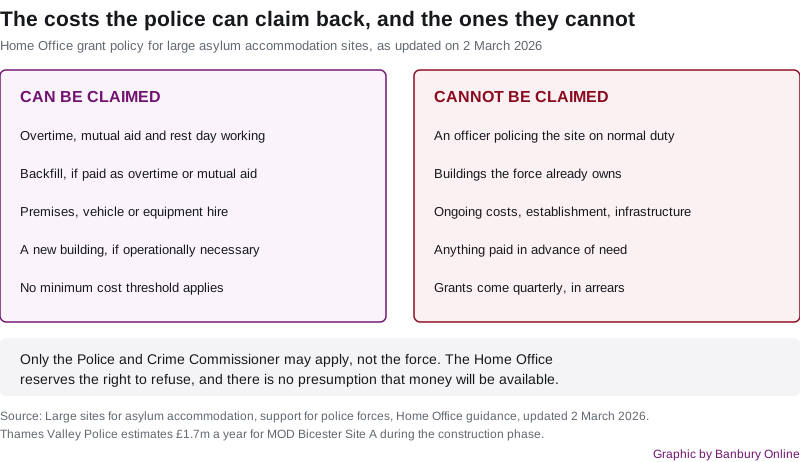
The guidance says the funding “does not cover opportunity costs: for example, the cost of an officer engaged in policing the operation as part of their normal duty should not be included in the application”. Overheads such as the use of buildings are treated the same way if the force already owns the premises.
Its criteria annex goes further. Requests “should not be for ongoing costs or additional establishment and infrastructure”. Awards are “normally made quarterly in arrears”, and “normally no funding will be provided in advance of need”.
So the redeployment Barber describes, officers pulled off other work across the Thames Valley, is the one cost the scheme is designed not to pay for.
Three other features of the scheme are worth knowing:
- Only the commissioner can apply. The guidance is explicit that “the force is not able to make an application of its own volition”.
- There is “no presumption that financial assistance will be available”, and the Home Office “reserves the right to refuse a grant application”.
- Applications go to a Home Office panel with independent assurance from the police inspectorate, HMICFRS, and ministers take the decision.
Unlike the main Police Special Grant, there is no minimum cost threshold, and the Home Office says it will consider “all reasonable estimated costs, itemised and evidenced”.
The Home Office says the sites are meant to need fewer police
The same guidance sets out the department’s intention for these camps. “We aim to make the sites as self-sufficient as possible, thus minimising the impact on local communities and services,” it says. “This includes 24/7 security to reduce the need for police patrols.”
Barber’s letter is, in effect, a challenge to that assumption at this site.
£1.7m against a £622m budget
Thames Valley Police is running a £622 million budget in 2026/27, with almost half of it raised from local council tax, according to the commissioner’s budget statement in January. Householders in a Band D property are paying £15 a year more towards policing this year, which the commissioner put at 29p a week.
Set beside that, £1.7 million is a small share of the total. Set beside the force’s own savings plan it is not: Barber said in January that £15 million of savings were delivered last year, with a further £16 million planned over four years.
The force is also adding 53 neighbourhood police officers this year, on top of 218 over the previous three. Neighbourhood policing is the first demand the commissioner names for the camp.
He linked the request to other funding arguments he has already made. “Taxpayers in Thames Valley are already being asked to make up funding shortfalls in several areas of policing including the Government’s failure to fully fund the cost of new neighbourhood officers and the absence of additional funding for local state visits,” he said.
His ask of the government is narrow and specific: “I urge the Government to review the Home Office’s cost recovery policy in relation to large asylum sites before any further decisions on MOD Bicester are made.”
Where the application stands
The site is not in Bicester. Site A sits inside the former garrison off the B4011, between Piddington and Upper Arncott, about 4.75km from the town, in Cherwell’s Launton and Otmoor ward. Up to 1,256 asylum places are proposed. Piddington, the nearest village, has around 315 residents.
It is an Urgent Crown Development application, reference PCU/RARE/C3105/3378843, which means the Secretary of State decides it rather than Cherwell District Council. The application was validated on 2 September. The window for representations ran from 7 to 17 September and was not extended. No decision date has been published.
Cherwell District Council, Oxfordshire County Council and Bicester Town Council all objected before the deadline. What each of the three letters says is here. The commissioner’s letter is separate from those objections: it goes to the Home Office about money, not to the planning department about the scheme.
What it means for you
- Nothing about the camp is decided. The Secretary of State has the application and has not published a timetable.
- The £1.7 million figure is an estimate for the construction phase only, and it assumes permission is granted. No figure has been published for the years a camp would be running.
- If the government does not pay, the bill falls locally. Almost half of Thames Valley Police’s budget comes from council tax, so unfunded costs land on the precept or on other policing.
- Watch the neighbourhood teams, not just the money. The commissioner’s warning is about officers being moved, which would show up as less visible policing in Bicester, Banbury and the villages long before it shows up in a budget line.
- Thames Valley Police publishes recorded crime by street and month at data.police.uk, which is the check on what actually changes if the camp is ever built.
Our earlier coverage: the 11-day comment window, Cherwell’s officers urging refusal and the three councils’ objections.
Have your say