
The council says it put £703,884 of developer money into community projects. Its own statutory return shows £19,729,405 was still held at 31 March 2025, £4.9m of it for upkeep.
Cherwell District Council announced on 13 August that it had put £703,884.46 of developer money into more than 20 leisure and wellbeing projects across the district during the 2025/26 financial year, among them the millennium playground at Steeple Aston, a new kitchen at the Windmill Centre in Deddington and a refurbished multi-use games area at Hook Norton sports and social club. (Cherwell District Council, Section 106 funding delivers lasting benefits for residents)
The council’s own statutory return puts that spending in context. Cherwell’s Infrastructure Funding Statement for 2024/25, published in December 2025, reports that £19,729,405.30 of developer money received under planning obligations was still being held by the council at 31 March 2025. Of that, £4,917,409.36 is made up of commuted sums, money handed over specifically to pay for the long-term maintenance of things like play areas and open space, and intended to be drawn down slowly. That leaves roughly £14.8m that is not maintenance money. (Cherwell District Council, Infrastructure Funding Statement 2024-25, table 8)
More comes in than goes out
Councils have to publish an Infrastructure Funding Statement by the end of each calendar year, under the Community Infrastructure Levy (Amendment) (England) (No. 2) Regulations 2019. Cherwell does not charge the Community Infrastructure Levy, so everything in its statement comes from Section 106 agreements, the legal deals signed with developers when planning permission is granted.
Across the three years the statement covers, £7,779,868 came in and £2,761,312.92 went out.
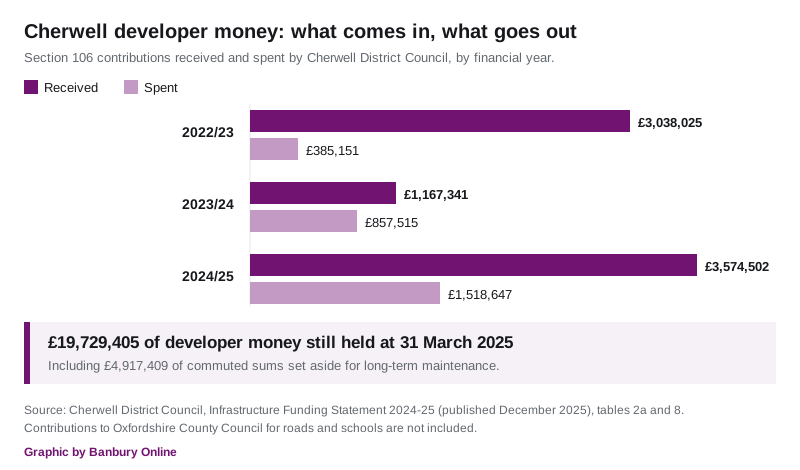
In 2024/25 alone the council received £3,574,501.75 and spent £1,518,646.95, a gap of just over £2m in a single year. The year before that it received £1,167,340.94 and spent £857,514.69, and in 2022/23 it took £3,038,025.31 and spent £385,151.28.
The council addresses the gap directly in the statement, at paragraph 3.13: the difference “will result from year-on-year variation and some infrastructure projects being delivered across multiple years, thus the spending may not occur during the reporting year”.
It is also worth being clear about what the £19.7m is not. Section 106 money is tied by the agreement to a stated purpose, often a named facility on or near a named site, and much of it cannot legally be spent on anything else. Contributions for roads and school places do not appear in this figure at all: those go to Oxfordshire County Council, which publishes its own statement. And the council reports that only £84,245.24 was formally unallocated at the end of the year, a single historic car park commuted sum it says it is still trying to identify. “Allocated”, though, only means the money has been passed to a team inside the council, not that it has been assigned to a project or spent.
Where the money went in Banbury
The appendices name every payment. The largest single item in 2024/25 was in Banbury: £239,873.47 spent on a multi-use games area, plus £107,335.04 on the public open space around it, both drawn from the same 2013 planning permission (13/00159/OUT), a total of £347,208.51 on one scheme. A further £422,331.02 of affordable housing money in Banbury came from application 01/00588/F, a permission granted in 2001. (Infrastructure Funding Statement Appendices 2024-25, appendix 5)
Some of the sums released last year are older still. The council spent £8,822.21 on maintaining a Banbury play area under a permission from 1995 (95/01117/OUT), £2,836.85 on another under a 1997 permission (97/01513/F), and £1,766.65 at Fritwell under one from 1996. Money agreed when a housing estate was approved can sit for a quarter of a century before it reaches the ground.
Beyond Banbury, the 2024/25 spending included £130,585.69 for Thames Valley Police, including CCTV and a contribution triggered at the 450th occupation of a Bicester development, £82,221.01 on refuse and recycling bins, £70,529.46 on village halls and community buildings in Ardley, Deddington, Launton and Steeple Aston, and £28,694.99 on the council’s own monitoring fees.
This year’s figure is close to flat
The £703,884.46 the council announced this week covers leisure and community projects. The equivalent categories in 2024/25, sports, open space and leisure, community facilities and community development, came to £697,170.33. On the council’s own numbers, then, spending on community and leisure facilities has stayed almost exactly where it was, and represents about 3.6 per cent of the money being held.
Meanwhile the pot keeps growing. The 19 new Section 106 agreements Cherwell signed in 2024/25, seven of them variations of existing deals, secured an estimated £6,247,080.20 in contributions along with 555 affordable homes.
Councillor Chris Aramini-Brant, deputy leader and portfolio holder for planning and enforcement, said securing the funding was “a vital part of making sure development works for our residents”. Councillor Lesley McLean, the council’s leader, said she was “thrilled to see how the funding we have secured is making a real difference”.
What it means for you
If a development near you was supposed to pay for a play area, a village hall extension or a sports pitch, the record is public and you can check it yourself. Appendix 2b of the appendices document lists contributions secured by area and by application, so you can look up your parish and see what was promised. Appendix 3 shows what has actually been received and appendix 5 what has been spent.
If money was promised but nothing has appeared, the planning application reference in those tables is the thing to quote. Copies of the agreements themselves can be downloaded from the Cherwell planning register or requested from the council by email. Parish and town councils are often the ones that apply for this money, so a parish council meeting is usually the fastest place to ask why a contribution is still sitting there.
The next statement, covering 1 April 2025 to 31 March 2026 and including the £703,884.46 announced this week, is due to be published by the end of December 2026. That will be the first document to show whether the amount held has started to come down.
For what is being built and where, see our guide to Cherwell planning and the district’s housing land supply.
Have your say