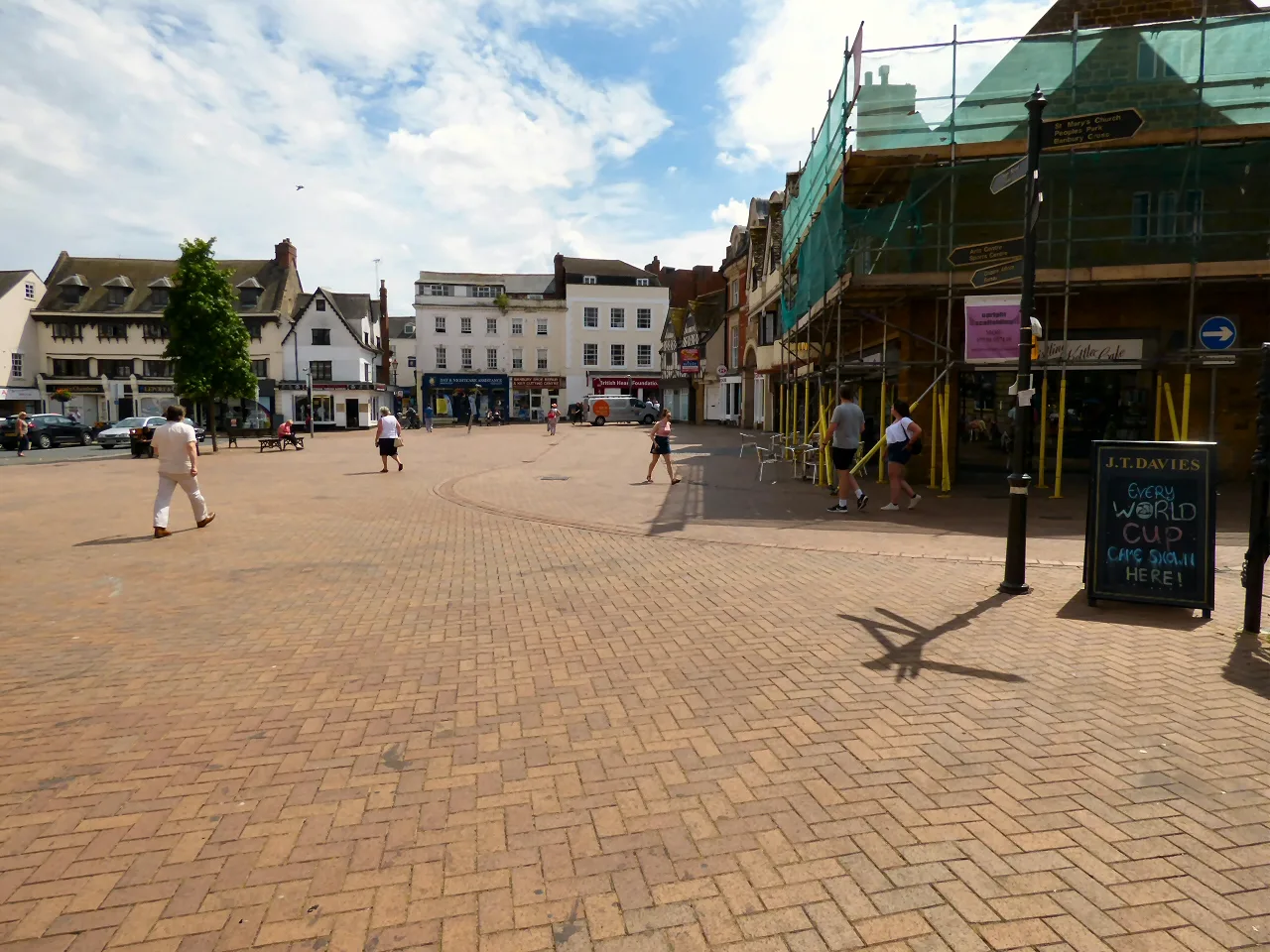

Cherwell has signed off £100,000 to replace or repaint Banbury's benches, bins and planters. The £21,500 weekend cleaning trial started on 1 September.
Cherwell District Council has agreed to spend £100,000 replacing and repainting street furniture in Banbury town centre. The money buys work on 73 benches, 24 bins and around 90 planters and planter columns, and it was signed off at the Executive meeting on 7 September.
It is the second Banbury project funded from the council’s new Local Area Development Funds this year. The first was the £21,500 weekend street cleaning trial the council announced on 17 September. That trial had already been running for more than a fortnight: the council’s own report to the Executive records that delivery started on 1 September.
What the £100,000 buys
The outline business case breaks the money down like this:
The work covers benches, recycling bins and other cast iron street furniture, including hanging basket columns and planters. The council’s street cleansing team will do most of it, with an external contractor brought in for the painting.
One detail is worth knowing if you are counting benches in Market Place. Seven of the 73 are there, and the business case says they may instead be picked up as part of the county council’s separate Market Place Improvements Project.
The project went to the Banbury Area Oversight Group on 5 August. Seven councillors attended and voted for it 7 to 0. The group is chaired by the deputy leader of the council, who is also portfolio holder for planning and enforcement.
The cleaning trial, in detail
The council’s news release on 17 September described the first phase as enhanced street cleaning with two deep clean events. The business case behind it is more specific about what actually changes at the weekend:
- the driver labourer hours go up from 4.5 to 7 on Saturday and Sunday
- total labourer hours go up from 3 to 5 on Saturday and Sunday
- a 3-hour sweeper driver shift is added every Saturday morning
- deep cleans use 10 operatives for six hours on a Saturday
The £21,500 covers 30 weeks, from 1 September 2026 to 31 March 2027. Roughly £14,500 of it is the extra weekend hours, about £5,000 is the deep cleans and about £2,000 is a 10 per cent contingency.
There is a wrinkle in the deep cleans. The business case describes them as quarterly, but because the trial starts part way through the financial year, only two are paid for this year. A full year would cost £38,500, a figure the report gives as indicative only. It has not been approved.
The staff doing the extra hours are existing contracted employees working voluntary overtime. The report says HR confirmed there would be no changes to anyone’s contract.
The reason the work is aimed at weekends is in the business case too. Ward councillors and other stakeholders raised the appearance of the town centre on weekend mornings, following activities in the town centre on Friday and Saturday evenings.
Where the money comes from, and how much is left
The Local Area Development Funds are new this year. Full Council agreed them on 23 February 2026 as part of the budget: three funds of £300,000 each, one for each of the district’s three main urban centres and their surrounding areas, for two years. The council’s medium term financial strategy assumes a third year at £233,000 each.
That is £900,000 for 2026/27. Two tranches have now been allocated:
- July 2026: £21,500, all of it to Banbury, for the cleaning trial. Bicester and Kidlington put forward nothing.
- September 2026: £524,000, across all three areas.
So £545,500 of the £900,000 has been committed, leaving about £354,500 for the rest of the financial year.
The September tranche is worth setting out in full, because most of it is not in Banbury:
| Project | Cost | Area |
|---|---|---|
| Banbury Town Centre Revitalisation Look and Feel Phase 2 | £100,000 | Banbury |
| Pioneer Square conveniences, Manorsfield Road | £26,000 | Bicester |
| Langford Village Park improvements | £100,000 | Bicester |
| Dangerfield Nature Reserve boardwalk | £60,000 | Bicester |
| Sports pavilion, RIBA stages 2 to 4 | £33,000 | Kidlington |
| Green spaces improvements, Yarnton | £110,000 | Kidlington |
| Town centre improvements | £30,000 | Kidlington |
| A4260 corridor study, Kidlington roundabout to Langford Lane | £45,000 | Kidlington |
| Community Insight Fund | £20,000 | Kidlington |
The Yarnton green spaces work and the A4260 corridor study are match funding towards wider schemes. The Executive also agreed to add £47,281 of section 106 money to the Yarnton project, taking that scheme’s budget to £157,281.
Despite the name, the A4260 corridor study is a Kidlington project, not a Banbury one. It covers the Oxford Road and Banbury Road corridor between Kidlington roundabout and Langford Lane, and Oxfordshire County Council would deliver it.
The council’s own risk assessment says the funds exist in part to “mitigate a risk that our urban centres are not treated equally”.
What it means for you
- You should already be seeing the extra weekend cleaning. It started on 1 September and runs to 31 March 2027, with the pre-Christmas trading weeks the main target.
- The bench and bin work has not started. The Executive approved the money on 7 September and delegated the final cost plan to officers. No start date has been published.
- If you want a project in Banbury funded from this pot, the route is the Area Oversight Group, through a ward councillor. Both Banbury projects so far came from that group, in June and August.
- About £354,500 of this year’s £900,000 is still unallocated across the three areas.
The reports are on the council’s committee site: the July allocation and the September allocation. For what is closed in town while the work goes on, see Banbury roadworks and travel, and for the car parks, parking in Banbury.
Have your say