
The inspector ruled the plan's 911 homes a year meets 81% of the 1,118 threshold, one point clear. The 20,042-home plan now goes to hearings this autumn.
The Cherwell Local Plan has passed the gateway test that could have forced the council to start large parts of it again. It passed by a single percentage point.
The examining inspector, David Spencer, ruled on 20 August that the plan’s draft housing requirement of 911 homes a year meets 81% of the local housing need figure of 1,118 a year. The threshold is 80%.
Because it cleared that bar, the plan will be examined against the December 2023 version of the National Planning Policy Framework rather than the December 2024 version. The council announced the outcome on 25 August, but its news release described it only as satisfying “the relevant transitional arrangements”. The inspector’s letter, published as examination document CLPR/ED63, sets out the arithmetic.
The plan covers Banbury, Bicester, Kidlington and the district’s villages, and runs from 2020 to 2042.
What the test was
Paragraph 234a of the 2024 framework lets a plan carry on under the old rules if it meets two conditions:
- it reached its pre-submission publication stage on or before 12 March 2025
- its draft housing requirement meets at least 80% of local housing need
Cherwell cleared the first easily. Its Regulation 19 publication ran from 19 December 2024 to 25 February 2025, and the plan was submitted for examination on 31 July 2025.
The second was the contested one, and it turned on what counts as the “draft housing requirement”.
The number that decided it
Policy COM1 of the submitted plan sets a single requirement for the whole district: 20,042 homes between 2020 and 2042, an average of 911 a year. That figure is two things added together. One is Cherwell’s own housing need, 15,629 homes or 706 a year. The other is 4,400 homes the council has committed to build towards Oxford’s unmet housing need.
The inspector was asked to strip the Oxford homes out and compare Cherwell’s own need against the 2024 standard method figure. Do that and the plan scores about 64%, which would have failed.
He declined. Paragraph 234a, he wrote, “does not say the housing requirement, for the purposes of transitional arrangements, should exclude unmet needs from neighbouring areas”. On a straightforward reading, 911 against 1,118 is 81%.
He acknowledged what that leaves unresolved. Counting the Oxford homes in the requirement means “a significant proportion of Cherwell’s latest local housing need would not be met by the Plan. That may be the case, but the wording of paragraph 234a does not invite such an analysis.”
He also confirmed the examination will proceed on the basis that Cherwell’s contribution to Oxford’s unmet need is 4,400 homes to 2042.
Where the homes would go
The plan requires 20,042 homes but plans for a supply of 24,587. The extra 4,545 are contingency, plus homes to deliver more social and affordable housing. Of that total, 4,477 homes were already completed between 2020 and 2024.
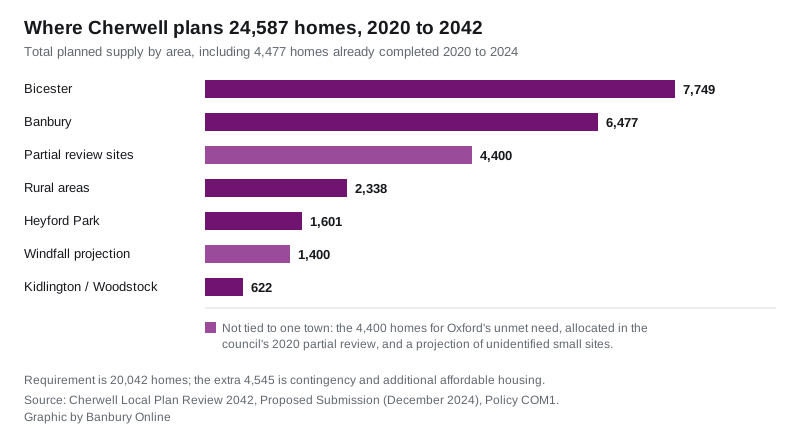
Bicester takes the largest share at 7,749 homes and Banbury 6,477. The rural areas account for 2,338, Heyford Park 1,601 and Kidlington and Woodstock together 622. A further 1,400 is a projection of small unidentified sites coming forward. The 4,400 partial review sites are the Oxford commitment, allocated in the council’s 2020 plan rather than this one, and are not counted under a town.
Most of that supply is already in the pipeline: 21,402 homes are either built, permitted or allocated. The plan adds another 3,185 on top:
- East of Bloxham Road, Banbury, phase 2, about 600 homes on 32 hectares
- south east of Woodstock, 450 homes
- Calthorpe Street, Banbury, 170 homes
- a rural allocation, 565 homes
- a windfall projection of 1,400 homes from 2027 to 2042
Separately, the plan extends the existing site at North West Bicester by 1,500 homes. Of that site’s 7,500 homes in total, 3,200 are expected to be built within the plan period and 4,300 after 2042.
The Banbury site is bounded to the south by Wykham Lane. The plan says no vehicular access will be permitted from the lane, and requires a landscape buffer along it and around the Grade II listed Wykham Farmhouse to the east.
What happens next, and when
The inspector was blunt about the delay. “I am acutely aware that the Plan was submitted just over a year ago. The examination now needs to move forward at pace.”
The dates that follow from his letter:
- 25 September 2026: the council must submit housing land supply templates for every allocation in the plan, and for the 2020 partial review sites
- this autumn: hearing sessions, covering land requirements, spatial strategy, which sites are allocated and whether they can be delivered, infrastructure and housing land supply
- 1 April 2027: the date the inspector will use as the start of the five-year housing land supply period, which is the year he expects the plan to be adopted
Most development management policies will be dealt with in writing rather than at hearings, to speed things up. Hearing dates and venue will be formally notified, and everyone who made a Regulation 19 representation will be told when the inspector issues his main Matters, Issues and Questions.
He is not inviting responses to the 20 August letter itself.
Three inspectors in a year
The examination has changed hands twice. Inspectors J Ayres and D Hendley, who ran the February hearings, stood down in July because of work commitments. David Spencer was appointed in their place on 9 July. A second inspector, L Hughes, was appointed alongside him on 24 August, according to the council’s examination updates page.
Mr Spencer decided against re-running the February hearings, judging that “everyone has had a fair opportunity to present their position on initial procedural matters”.
One question he has flagged for later is whether the 2020 base date for the plan period is still justified. Re-basing the housing requirement to a later start year would change the arithmetic behind the whole plan.
What it means for you
If you objected to a site near you at Regulation 19 stage, your representation stands and you will be notified of the hearings. You do not need to do anything now, and the inspector has specifically said he is not taking further comment on this letter.
If you did not comment at Regulation 19 stage, this examination is not open to new representations. The next chance to comment will be if the inspector recommends main modifications, which are consulted on separately before adoption.
Until the plan is adopted, planning applications are decided against the existing 2015 Local Plan and the 2020 partial review, alongside national policy. We track decisions on our Banbury planning news page, and the market those homes are being built into on our Banbury house prices page.
Have your say