
Cherwell refused three giant warehouse schemes at M40 J10, then dropped its defence at appeal. The inquiry sits in Banbury this week; a parish fights on.
The public inquiry into three huge warehouse schemes at Baynards Green, by Junction 10 of the M40, returns to Banbury on Tuesday. The council that refused them will not be arguing against them.
Cherwell District Council’s Planning Committee refused all three in January. In May, the council told the Planning Inspectorate it would not bring evidence to defend those refusals. The case against the warehouses is now being made by Stoke Lyne Parish Council and the Tusmore Park Estate, which have hired their own lawyers and expert witnesses.
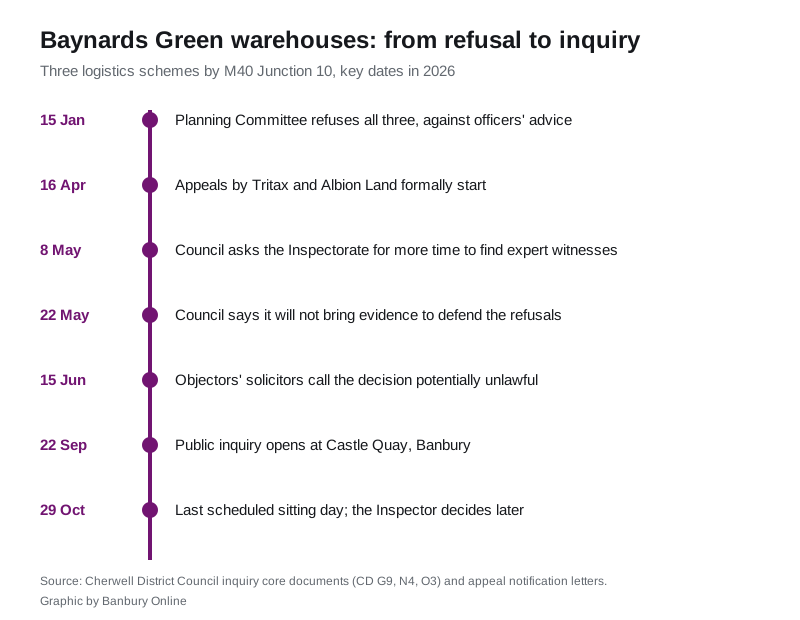
Baynards Green is about five miles north of Bicester and nine miles south-east of Banbury. The inquiry is expected to run for up to 18 sitting days, ending on 29 October.
What is proposed
There are three outline applications, all on farmland beside the A43:
| Application | Developer | Floorspace |
|---|---|---|
| 22/01340/OUT, east of Baynards Green Farm | Tritax Symmetry Ardley Ltd | 300,000 sq m of logistics |
| 21/03267/OUT, south-east of Baynards House | Albion Land | 100,000 sq m of logistics, 7,000 sq m of offices |
| 21/03268/OUT, north-west of Baynards House | Albion Land | 170,000 sq m of logistics, 10,000 sq m of offices |
The floorspace figures come from the council’s officer report on the Tritax scheme. That report puts the Tritax site alone at about 83 hectares. The developer’s consultants estimated it would support up to 2,430 on-site jobs once running, and about 500 during construction.
Objection was heavy. The same report records 515 letters of objection to the Tritax scheme before the Planning Committee of 3 July 2025. A later round of consultation drew 79 more comments: 29 objections and two letters of support.
How the council’s position changed
Council officers recommended approval. On 15 January 2026 the Planning Committee refused all three anyway. The decision notice for the Tritax scheme says the buildings’ “exceptional height, scale, massing and expansive roof profile” would be “wholly out of keeping” with the rural North Oxfordshire landscape. A second reason cited the lack of a legal agreement to pay for transport, landscape and ecology mitigation.
The developers appealed. What happened next is set out in documents the council has published for the inquiry:
- 8 May: the council’s legal team asked the Inspectorate for more time. It said it intended to appoint external expert witnesses and had already instructed leading counsel.
- 22 May: the council’s Executive Director of Place and Regeneration, Ian Boll, emailed the objectors’ solicitors. He said the council had told the Inspector that, subject to an acceptable planning obligation, “it does not intend to bring forward evidence to defend the reasons for refusal”. He added: “I understand that this may be unwelcomed and surprising news to you.”
- 10 June: a council note said it “was unable to find suitable expert evidence to support all of the reasons for refusal”. The decision was taken by the Monitoring Officer, after consulting the Leader, Deputy Leader and the portfolio holder.
- 15 June: solicitors for the parish council and the estate wrote that their clients were “concerned that the decision taken was unlawful”. They asked for information to advise on a judicial review.
- 22 June: the council replied that nothing unlawful had happened.
All of that correspondence is in the council’s bundle on its withdrawal.
Why the council says it stepped back
The council’s 22 June letter gives the fullest explanation. It says it tried to appoint experts on landscape, need and economic benefits, ecology and planning. None of those it approached on planning, ecology, or need and economic benefits agreed to take the job. The letter does not say the same of landscape, the subject of the main reason for refusal.
Without them, the letter says, the council “could not maintain its reasons for refusal”. It also says the Chair and Vice-Chair of the Planning Committee were told of the decision and agreed with it. There was no Planning Committee sitting at the time, because of May’s local elections.
The objectors dispute that account. Their solicitors say they received quotes from three landscape witnesses willing to act. They also say one landscape witness they had considered was later approached by the council, and that they told him they were content for him to work for it.
Stoke Lyne and Tusmore are now running the full case themselves. They have filed evidence on landscape, economic need, ecology, planning and transport.
Another party has dropped out. Oxfordshire Railfreight Limited, which is promoting a strategic rail freight interchange through the national consenting regime, had registered in the appeals. On 14 July it withdrew, saying there was a “clear need” for all the floorspace in both projects up to 2042.
When and where the inquiry sits
The Inspector is J Woolcock. The council’s inquiry page lists the remaining sessions:
| Dates | Venue |
|---|---|
| Tue 29 Sep to Thu 1 Oct | Council Chamber, Castle Quay, Banbury |
| Tue 6 to Thu 8 Oct | Bicester Hotel Golf and Spa, Chesterton |
| Tue 13 to Thu 15 Oct | Bicester Hotel Golf and Spa, Chesterton |
| Wed 21 to Fri 23 Oct | Council Chamber, Castle Quay, Banbury |
| Tue 27 to Thu 29 Oct | Council Chamber, Castle Quay, Banbury |
The same page carries a live stream link by 9am on each sitting day, and recordings of earlier sessions.
What it means for you
- You can go. The inquiry is in person and open to the public. Space in the Council Chamber is limited, so the council asks anyone planning to attend to email submit.appeal@cherwell-dc.gov.uk first. The notification letter says the Chamber entrance is opposite Shire Mobility in Castle Quay South Car Park, not the shopping centre reception.
- You may be able to speak. Members of the public can give their views at the Inspector’s discretion.
- You can read everything. Every proof of evidence, from the developers and the objectors, is in the core documents linked from the inquiry page.
- The decision rests with the Inspector. It will be published on the Planning Inspectorate’s appeals casework portal after the inquiry closes. No date has been given.
For context, the council’s own appeals report to the 24 September Planning Committee says 31 appeals against Cherwell decisions have been decided so far this year. Nine were allowed, 21 dismissed and one split. That report lists four public inquiries waiting to be heard; three of them are these schemes.
We track other major applications on our Banbury planning news page.
Have your say