

Employers will have to put the salary in every job advert under a planned law backed by Banbury MP Sean Woodcock. No start date has been set for it yet.
Employers will have to say what a job pays in every job advert under a planned new law, and Banbury’s MP Sean Woodcock has come out in support of it. Nobody applying for a job in Banbury, Bicester or anywhere else in the country would then have to guess what lies behind “competitive salary”.
The government announced the plan on 5 November. It said it will “bring forward legislation as soon as possible”, but it has not given a date, and the detail of which adverts are covered and how the rule will be enforced has not been published. Until then the Prime Minister, Andy Burnham, is asking businesses to publish salaries now rather than wait for the law.
What the government says is wrong now
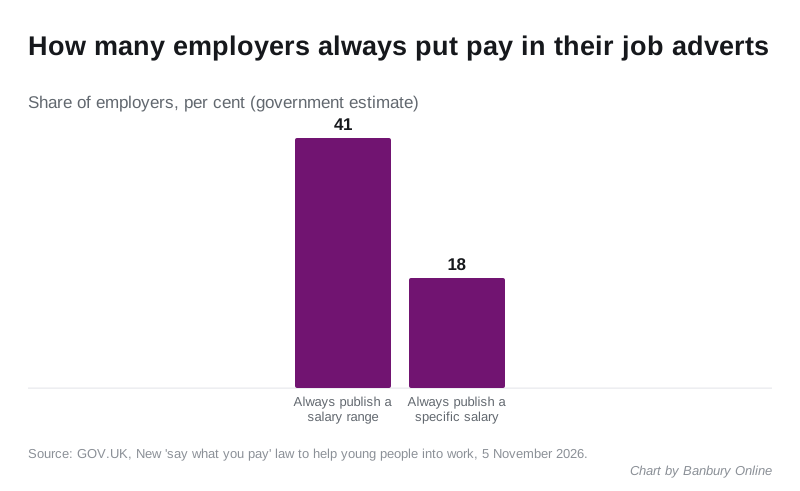
The government estimates that fewer than half of employers (41%) always publish a salary range, and only one in five (18%) always publish a specific salary.
It says early analysis of its consultation found 94% of respondents backed making salaries compulsory in adverts, including 93% of the businesses that replied.
Its case is that hidden pay makes unfair differences harder to spot and to challenge, leaves women “to negotiate blind” and more exposed to lower offers, and wastes the time of young people applying for their first jobs.
What Sean Woodcock said
Mr Woodcock, the Labour MP for Banbury, said in a statement from his office:
“People looking for work deserve honesty from employers. Applying for a job can be a major life decision, but too many applicants are expected to invest time and effort without knowing one of the most important details: the salary.
“While job adverts often set out every qualification, responsibility and expectation, many still fail to tell candidates what they will actually be paid.
“That lack of transparency can reinforce existing inequalities, particularly for women, who continue to face barriers in securing equal pay. Bringing salaries into the open would help shine a light on unfairness and support greater accountability.
“It would also give young people and working families the information they need to plan their futures with confidence. People should not have to guess whether a job will cover their rent, mortgage or childcare costs.”
He said employers “across Banbury and North Oxfordshire are already showing that publishing salary information is both straightforward and beneficial”, and that the change would “help ensure that transparency becomes the norm rather than the exception”. His statement did not name those employers.
“Put simply, if employers know what a job is worth, applicants should know too,” he said.
The minister and the campaigners
Bridget Phillipson, the Minister for Women and Equalities, said: “What a job pays is rightly at the forefront of people’s minds when looking for work, it shouldn’t be a guessing game.
“Mandatory salary information on job adverts will help young people make informed choices, help close the gender pay gap, and tackle an everyday annoyance that can stand in the way of applying for a job.
“Whether it’s a young person looking for their first job or a mum getting back into work, no-one should have to enter an already daunting process salary blind.”
Penny East, chief executive of the Fawcett Society, which campaigns on women’s pay, told the government the decision was “real progress” and that salary secrecy had left women “negotiating in the dark”.
What it means for you
- Nothing changes yet. The law has not been written or passed, and there is no start date. Employers can still advertise without a salary until it is.
- If you are looking for work now, an advert with no figure is still legal. Asking for the pay range before you apply is reasonable, and the government is openly urging employers to give it.
- If you hire in the Cherwell district, the government wants salaries in adverts now. The rules on which roles count, and on enforcement, are still to come.
There were 2,490 people claiming out-of-work benefits in Cherwell in September, 2.3% of residents aged 16 to 64, according to the latest ONS figures.
Sources
- GOV.UK, New ‘say what you pay’ law to help young people into work, 5 November 2026
- Statement from the office of Sean Woodcock MP, 9 November 2026
Have your say